Gerry Anderson's UFO
Realizing I’d completely forgotten about this series!!
I never knew. A blog by Patrick Tanguay. Autodidact. Generalist. Synthesist. Writes Sentiers, a carefully curated weekly newsletter on the futures of technology, society, and culture. ◌ Feed.
Realizing I’d completely forgotten about this series!!
Love this quote! Mostly noted for the future generations and planet bits but it’s also a great way to look at the current pandemic and mask wearing. We have an obligation to others to wear masks to protect them. Even with all we know, too many people still see it as whether they feel they need to protect themselves. That’s not the point!
The single biggest thing I learned was from an indigenous elder of Cherokee descent, Stan Rushworth, who reminded me of the difference between a Western settler mindset of “I have rights” and an indigenous mindset of “I have obligations.” Instead of thinking that I am born with rights, I choose to think that I am born with obligations to serve past, present, and future generations, and the planet herself.
Source: The End of Ice - Lion’s Roar
Hallin’s spheres is a theory of media objectivity posited by journalism historian Daniel C. Hallin in his book The Uncensored War to explain the coverage of the Vietnam war. Hallin divides the world of political discourse into three concentric spheres: consensus, legitimate controversy, and deviance. In the sphere of consensus, journalists assume everyone agrees. The sphere of legitimate controversy includes the standard political debates, and journalists are expected to remain neutral. The sphere of deviance falls outside the bounds of legitimate debate, and journalists can ignore it. These boundaries shift, as public opinion shifts.
Source: Consensus, legitimate controversy, and deviance – Doug Belshaw’s Thought Shrapnel
This Guardian piece has been making the rounds, they title it like it’s written by a “robot” by itself but it’s actually eight different “essays” edited together. Austin Kleon has an excellent take on it.
“We chose instead to pick the best parts of each… We cut lines and paragraphs, and rearranged the order of them in some places.” Honey, that means a human wrote this piece. Writing is editing. It is about making choices. So you fed a robot a prompt, got eight different “essays,” and stitched together the best parts to make a piece of writing? Congratulations, human! You’ve just outsourced the easiest parts of writing and kept the hardest parts.
— This post is Day 7 of my #100DaysToOffload challenge. Want to get involved? Find out more at 100daystooffload.com
Very interesting thought by Robin Sloan, on what he calls orthographic media. Here’s the Wikipedia definition of orthographic projection.
Orthographic projection is a means of representing three-dimensional objects in two dimensions. It is a form of parallel projection, in which all the projection lines are orthogonal to the projection plane, resulting in every plane of the scene appearing in affine transformation on the viewing surface.
In other words, objects are not scaled for distance in a three dimensional scene. Robin’s insight is that perhaps social media is kind of the same way; we don’t know how far / important each event is.
Browsing Twitter the other day, I once again found myself sucked into a far-off event that truly does not matter, and it occurred to me that social media is an orthographic camera. Imagine those colorful cubes in the orthographic projection above as tweets: all the same size, taking up the same amount of space on the canvas, even though some are way off in the distance while others brush the virtual camera’s lens. Maybe this is a flavor of context collapse: the standardization of all events, no matter how big or small, delightful or traumatic, to fit the same mashed-together timeline.
@robinsloan https://www.robinsloan.com/notes/orthographic/
Which I find is a very interesting way of thinking about what we see in our feeds. Quoted here for later reference but also because it reminded me of this by Doug Belshaw. https://twitter.com/dajbelshaw/status/1299293497602736128 Checkout the short video where he shows the links from his feed using Nuzzel and realizes that he doesn’t care all that much about what’s there. I partially agree with him, for example my healthcare feeds (for a client) are completely “polluted” by COVID, including many who are definitely not bringing any value and just looking for clicks. However, I do work on my Twitter lists quite a bit, and my main list is full of useful and interesting things. I never look at the main feed (everyone I follow) on Twitter or through Nuzzel but it probably looks like Doug’s. To attach this to the orthographic media above:
To stray even further, this makes me think of an article I included in Sunday’s Sentiers, concerning a piece by Drew Austin, The cloud and the countryside.
the growing separation between “people from anywhere” and “people from somewhere,” essential workers and all place-dependant work. The “Zoom class” and its “‘Zoom city’ currently being layered onto existing settlements.”
https://sentiers.media/the-cloud-and-the-countryside-pace-layering-the-tyranny-of-chairs-no-139/
He’s talking about the physical world and how remote work changes where we live but the being anywhere angle fits here too. With orthographic media, we are all from nowhere, with no perspective or distance from all news. Using a non-orthographic view, we could “be from” a specific viewpoint. — This post is Day 6 of my #100DaysToOffload challenge. Want to get involved? Find out more at 100daystooffload.com

Interesting mini-trend with a couple of countries offering new year-long “digital nomad” visas.
Digital nomads and remote workers have long faced ambiguity when working while they travel, often skirting the law by working while visiting a country with a tourist visa. While other countries like Costa Rica, Mexico, Portugal and the Czech Republic have introduced visas for digital nomads, so far these have primarily targeted freelancers.
In contrast, the new Estonian Digital Nomad Visa (DNV) covers a broader range of digital nomads — in addition to freelancers, it also allows teleworking from Estonia if the person has a foreign employer or is a partner in a company registered abroad. This is great news for location-independent entrepreneurs around the world as it provides a legitimate way to live and work here for up to a year.
They only accept people with actual proven revenu as freelancers, company owners, or employees with a contract so it really is a working abroad visa, not a loose visiting one. I don’t see any direct mention of it so I’m not sure how that translates in terms of European travels but it probably means you could spend the bulk of your time in Estonia and use it as your base for multiple short trips across the continent. The second one is much less interesting, to me anyway, but is useful as a second example of a potential new trend.
The government of Barbados has announced that it could soon be introducing the 12-month “Barbados Welcome Stamp” to allow visitors the option to work remotely from the island for a year at a time. [Editor’s note: applications opened on July 24 and the stamp costs US$2,000 per person or US$3,000 for families.] The visa would allow people “to come and work from here overseas, digitally so, so that persons don’t need to remain in the countries in which they are”, said Prime Minister Mia Amor Mottley. “You can come here and work for a couple months at a time; go back and come back,” she said. The idea is based on the fact that the pandemic has shown that short-term travel is more difficult because of the requirements for rapid Covid-19 testing, which are not reliably available yet, and the fear people feel getting ill abroad.
@globetrender Barbados unveils one-year working holiday visas for digital nomads
This one is interesting because, where Estonia’s is a logical evolution of their e-Residency program, Barbados’ is an answer to travel restrictions related to COVID-19 and the sudden need for a different base of operations that some are feeling now. Looking forward to who offers some other variation next. Thailand? Iceland? Greece? — This post is Day 5 of my #100DaysToOffload challenge. Want to get involved? Find out more at 100daystooffload.com
Intel, you know, the OG American chip maker, is now placing orders with Taiwan’s TSMC because they can’t make 6nm microchips themselves. By the time Intel gets to 7nm and AMD to 5nm, TSMC will be down to 3nm.
For perspective, rival foundry TSMC plans to be on the 3nm node in the same time frame as Intel’s new schedule for 7nm. Intel clearly isn’t pleased with its execution on the 7nm node, as an embattled Swan remarked that “And we feel pretty good about where we are, though we’re not happy. I’m not pleased with our 7nm process performance” at the end of the call after a bruising question and answer session with analysts.
@tomshardware Intel’s 7nm is Broken, Company Announces Delay Until 2022, 2023
The nm size describes how tightly microprocessors can be packed together, one of the most important metrics right now to make processors faster and (I think?) consume less power. In related news, Apple have announced a switch to their own ARM-based processors, designed in-house and made by… TSMC. Which means that TSMC (and thus Taiwan) is now the center of the computing universe, holding the spice, as was so aptly said here:
The world’s principal supplier of semiconductors – the spice of OUR global empire – is now Taiwan. Forget about Hong Kong. Forget about the Uighurs. Forget about the virus. Forget about the Trade Deal. Forget about the South China Sea. Forget about all the reasons you’ve been told that the United States should or could be at odds with China. And by forget, I don’t mean that you should really forget. What I mean is that none of these reasons really matter anymore. None of these reasons are spice. None of these reasons are the supply of semiconductors – the sine qua non of modern global power. There is no future where the United States can both maintain its existential national interests and allow the world’s principal supplier of semiconductors to come under the direct political control of China. And there is no future where China can both maintain its existential national interests and allow the world’s principal supplier of semiconductors to remain outside its direct political control.
@EpsilonTheory https://www.epsilontheory.com/taiwan-is-now-arrakis/
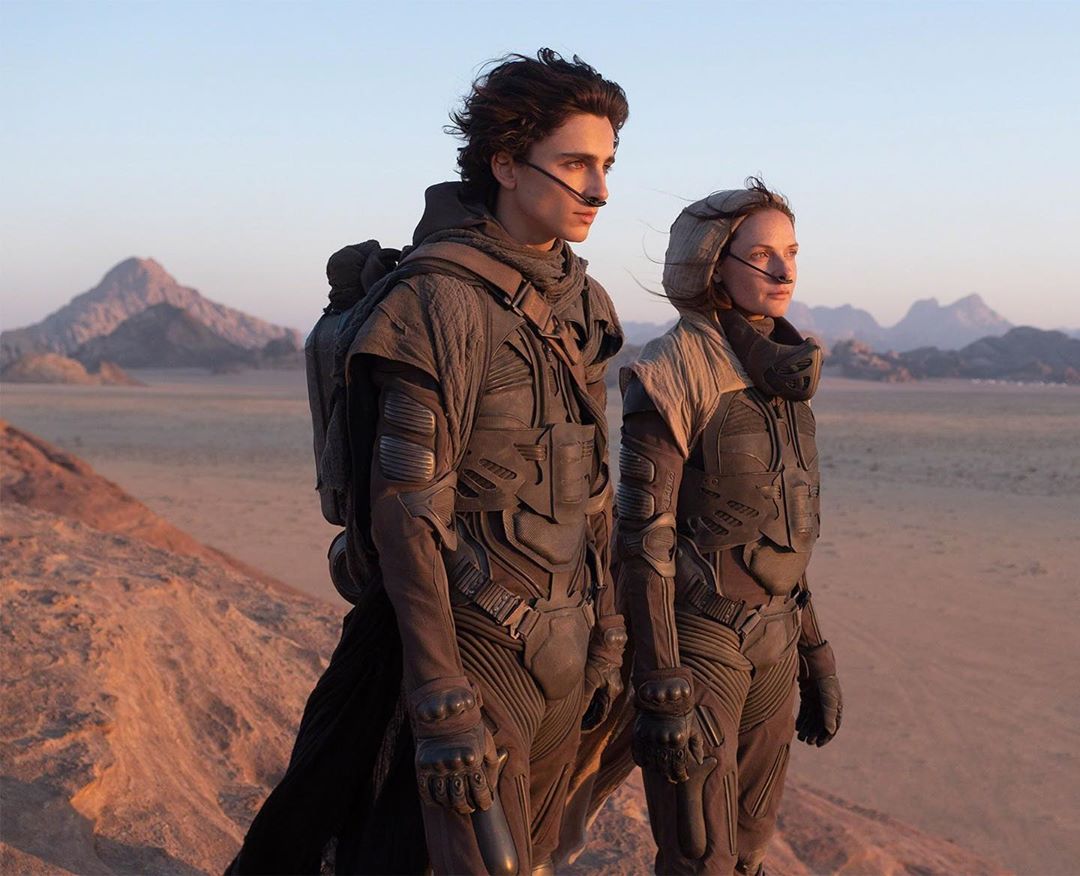
— Header image: Yes, I did use an image from Denis Villeneuve’s upcoming Dune and not the original. Local-boy bias. This post is Day 4 of my #100DaysToOffload challenge. Want to get involved? Find out more at 100daystooffload.com
So my internet friend Tom Critchlow decided to open up a Discord (originally a platform for gaming communities, including playing together live with the voice channels it includes) as a “semi-public space for realtime conversation.”
I’m planning on using it for:
- Longer/deeper discussions triggered from my blog or twitter (“take it to the discord!” instead of “take it to the DMs!”).
- A more persistent space for people who want to review blog post drafts
- A space to host real-time sessions
The plan is for this space to be fairly small, fairly quiet and more intimate than my public blog/twitter spaces.
@tomcritchlow https://tomcritchlow.com/2020/07/08/discord/
A few interesting things about Discord:
A nice 4. would be no-account, password-protected invite links (à la Zoom) to distinct channels so you can invite people for one conversation, which they could participate in with no Discord account and without seeing everything else the community is discussing. I also joined another Discord, this time launched by the writer of a newsletter I’m subscribed to (not sharing the link here, not sure how broadly he wants that to circulate). So this is, perhaps, one more frontier of Yancey Strickler’s Dark Forest Theory.
Is our universe an empty forest or a dark one? If it’s a dark forest, then only Earth is foolish enough to ping the heavens and announce its presence. The rest of the universe already knows the real reason why the forest stays dark. It’s only a matter of time before the Earth learns as well.
This is also what the internet is becoming: a dark forest.
In response to the ads, the tracking, the trolling, the hype, and other predatory behaviors, we’re retreating to our dark forests of the internet, and away from the mainstream.
Yancey Strickler https://onezero.medium.com/the-dark-forest-theory-of-the-internet-7dc3e68a7cb1
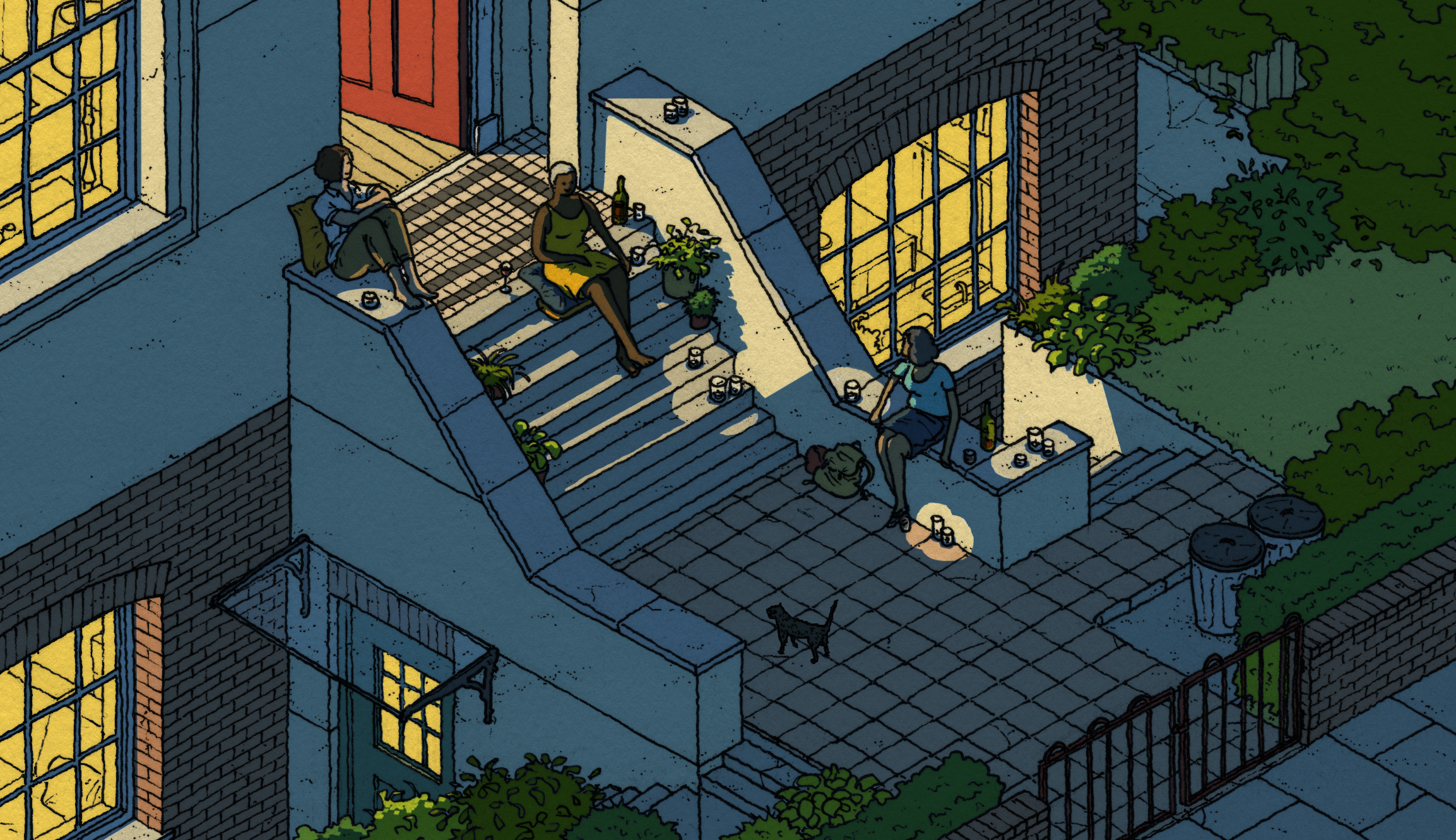
Except here Tom is not retreating from anything and it’s not a new group or place, it’s a new space adding to his Twitter account and blog. A dark front-steps-hangout maybe. — Header image: Owen D Pomery. This post is Day 3 of my #100DaysToOffload challenge. Want to get involved? Find out more at 100daystooffload.com

Récemment nous travaillions tous les deux face à face à la table de cuisine, confinement oblige. La scène m’a rappelé 2009 alors que nous avions passé trois mois à Berlin et travaillé de deux espace de coworking, souvent de cette façon; chacun de notre côté de la table. J’ai cherché une photo d’un de ces moments ce qui m’a évidemment emmené à «perdre» du temps à parcourir cette année là et la précédente. En 2007 j’ai:
Quatre voyages dans la même année, rencontre «life changing» et démarrage d’une entreprise. Quand même! J’écrit ça sans but précis (à part le défi 100DaysToOffload ;-) ), certaines années pré-enfant étaient vraiment remplies, et pourtant les années avec enfant, même sans gros voyage ou nouveau projet, sont complètement différentes mais aussi denses. — This post is Day 2 of my #100DaysToOffload challenge. Want to get involved? Find out more at 100daystooffload.com
So there’s this thing called 100 Days To Offload which, spur of the moment, I mentioned in a group chat and ended saying I’d try to do.
#100DaysToOffload is a simple concept that Kev Quirk thought of one day. The rationale behind the whole thing is to challenge people to publish 100 posts on their personal blog in a year. That’s approximately 1 post every 3.5 days. The point of #100DaysToOffload is to be a relaxing and cathartic experience. Not a worrisome affair where you’re thinking of things to write all the time. Posts don’t need to be long-form, deep, meaningful, or even that well written. If there are spelling and grammar mistakes, or even if there’s no real point to the post, so what? What’s important is that you’re writing about the things you want to write about. Your posts could be how-to guids, or links to another post you have found interesting. They could include your own thoughts about that post, or a response to it. It could be a simple update about what you have done that day. Tell us about your dog, your cat, your fish tank, or whatever hobbies you have. Someone will find it interesting.
My friend Clément decided to do it, and is of course already well on his way. One “trick” he’s using is recollecting old trips and note taken. I hadn’t necessarily thought a whole lot about either the challenge or his trick and then I bumped into this by Robin Sloan at Why is this interesting? where he’s remembering a visit to a great space / project / island in Amsterdam and mentions the squatting rules in the Netherlands.
This was De Ceuvel, a ramshackle creative hub built on a small polluted island. The deal was this: the island was destined for development—condos, probably—but before that could happen, the soil had to be cleaned, a process that would be undertaken by phyto-remediating grass and last about a decade. For that period, the island would be handed over to a creative organization and supported with a substantial subsidy. The group behind De Ceuvel won the opportunity and was granted a ten-year lease. This was in 2012. Today, a beautiful boardwalk winds through the tall grass, linking a collection of studios and offices built from the shells of old houseboats.
Guest Contributor https://whyisthisinteresting.substack.com/p/why-is-this-interesting-the-breeding
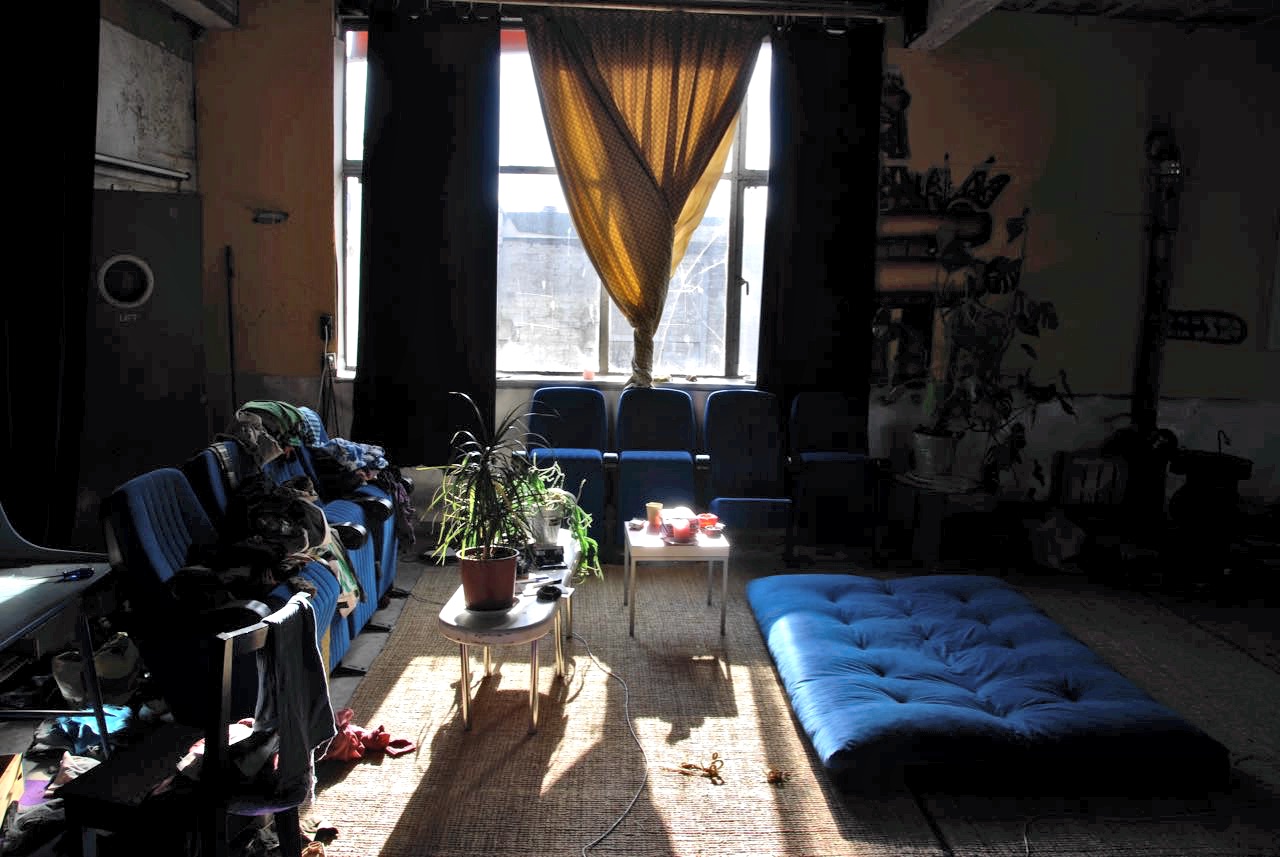
Which is when I remembered that in 2007, we visited a friend of my girlfriend’s in Rotterdam who had himself co-setup and co-lead a great squat space in the city. It’s also where I learned about the very interesting rules Robin mentions. It was an old Van Nelle Fabrik, big building along a canal with each person in the group claiming a part of a floor for their room, there was a big lounge with lots of recuperated sofas and where they showed movies, a big open two-story space where the friend in question stored his AV equipment, they’d built their own kitchen with a huge island counter where we had a great middle-eastern inspired lunch.  The whole thing looked a lot more like a building someone might buy on the cheap to renovate than what you might expect something labelled a “squat” to look like. At the time (not sure if it’s changed), if a building was left empty for X years and you managed to get in and live there for a while, you were granted occupancy rights and could stick around until a re-purposing project presented by the owner was approved. That group stayed there for a few years, were in discussions with the owner, made some renovations but were ultimately pushed out by a condo project. Another friend was also living in a squat elsewhere but he had a prior arrangement with the owners. He was basically occupying the space with a deal to leave when they asked, instead of them taking the chance that someone else would claim it and get some rights to occupy. Crazy but also logical in such a densely built country. — This post is Day 1 of my #100DaysToOffload challenge. Want to get involved? Find out more at 100daystooffload.com