Second page of the archive

Digital Sovereignty

Un article dense et fouillé par Robin Berjon qui permet de donner un cadre de réflexion sur la souveraineté numérique. Mon unique souci est que c’est un cadre de pensée qui est profondément ancrée sur les grands systèmes, qu’ils soient de gouvernement et/ou de compagnies. Je suis plutôt dans la recherche d’une recréation des communs, d’un véritable espace public (comme la bibliothèque, les chemins de randonnée, la place du marché, etc) re/lié par une forme d’indépendence très locale. Je peux donner 200 yens à mon enfant de main à main pour qu’il puisse acheter un daifuku à manger. Pas de traçabilité. Pas d’identifications. Une grande simplicité locale et une multitude de fournisseurs possibles. Je veux pouvoir héberger mon serveur Web, mail, etc pour moi et des amis à la maison, sans avoir à passer par de grosses entreprises et de gros centre de données capturant tout le flux. La naïveté est parfois un bon cadre pour trouver des solutions utiles.

Karl Dubost

Fireplace externalities

Fireplace externalities

Driving back from family travels for the holidays, two things happened on the way, which I thought connected in a useful way.

  • There was “dry smog” over Montréal, caused in good part by all the fireplaces burning wood to have nice holiday fires going for Christmas the day before.
  • On the radio, a short report on the popularity of fireplace videos on YouTube and Netflix.

When critiquing technology, we often talk about externalities and second order consequences. Dumping your electronics—or, often, even sending them to be recycled—means they eventually end up in landfills or somewhere in the global south, polluting their own lands and contaminating workers with deadly fumes.

Clothing, toys and much of everything, once made locally to the global north, where at least citizens might want to control working conditions, are made elsewhere, often in conditions we wouldn’t accept for our own citizens. Pollution regulations is nonexistent or vastly insufficient, or easily bypassed.

But all of these externalities are somewhere else, possibly unseen when they were made near you, now completely out of sight.

All of this to say that I thought the fireplaces were a nice, clear, easy to cite example of transferring externalities from your own sky to someone else’s. Burn your own real fireplace, you might have undesired smoke inside and will definitely send the rest outside, contributing to bad air conditions. Switch to Netflix, you get no odour, no smoke inside or out, and no smog. Somewhere else though, are massive servers guzzling water from the local aquifer, generating noise, and in some cases being powered by fossil fuels polluting yet another place, the region where the electricity is generated.

When you look at a holiday fireplace, there is smoke somewhere. Over your own head, or someone else’s.

Personal foundational texts

Personal foundational texts

This hex (tweet) circulated a bit over the last few weeks.

https://bsky.app/profile/karenattiah.bsky.social/post/3ld2et5ighs24

I don’t really have an “official” list of “personal foundational texts,” especially not books I reread, there are so many things to read, I tend to not reread anything. Except younger, where I reread Tintin and Spirou a few times.

In lieu of specific title, what I always come back to is a kind of healthy obsession for quirky scientists and brainy people in general. I loved the two bandes dessinées above, but my favourite characters weren’t the ones in the titles, they were Professeur Tournesol and the count, Pacôme de Champignac.

A couple of years ago, reading Back To The Victorian Future, I wrote this in Sentiers:

Finally, Morus also mentions Tesla as a variation on virtue, with “the inventor as an outsider who had no interest in the mundane world around him, a dreamer ‘who thinks too much’ and wanted ‘more than anything else to be left alone.’” And made me think of all the quirky and / or mad inventors I’ve loved in fiction, Professeur Tournesol, Pacôme de Champignac (and Zorglub), even Doctor Doom and a number of characters on this list of fictional scientists and engineers. I’ve always assumed I was recognizing fellow nerds, but now I’m wondering how it relates with these other archetypes.

Woven into the fabric of the story were assumptions about the relationship between personal virtue, technology and the road to a better future that were deeply ingrained in Victorian culture. For the Victorians, the future was — or could be — utopia, and individual personal virtue was instrumental in producing a collective virtuous future. […]

But Smiles was adamant that biographies of great men offered “illustrious examples of the power of self-help, of patient purpose, resolute working and steadfast integrity, issuing in the formation of truly noble and manly character.” […]

They demonstrated “that it is not the man of the greatest natural vigor and capacity who achieves the highest results, but he who employs his powers with the greatest industry and the most carefully disciplined skill — the skill that comes by labor, application and experience.” […]

“When we subscribe to this paradigm about how — and by whom — the future is made, we’re also relinquishing control over that future.”

I’d also add Sherlock Holmes and the more recent, very heavily inspired by Holmes, Aloysius Pendergast. Both detectives of sorts but with a very scientific mind and acerbic wit.

Curiosity, an eye for science, and a wide array of interests. The books they are featured in might not necessarily be a “personal canon,” but they definitely seem to have influenced me. Or of course, I was drawn to them because we “think the same way.”

The other oeuvre I immediately think of in this context, is all of William Gibson’s writing. Here are two quotes from him, you’ll easily see the connection.

Some speculative writers are architects: they build orderly worlds. But Gibson has a collagist’s mind. He has depicted himself as “burrowing from surface to previously unconnected surface.” His language connects contemporary jargon, with its tactical-technological inflections, to modern states of anxiety and desire.
—How William Gibson Keeps His Science Fiction Real

“Gibson’s writing is, on the most basic level, a testament to this obsession with the bizarre and the disturbing: he takes these random, abandoned fragments of our shattered society and fuses them together into a strange and beautiful mosaic of words,” Wershler-Henry writes. “The resulting gestalt, though, is more just than an artistic curiosity.”
—Conversations with William Gibson

Machines et esclaves

Comme bien des montréalais depuis quelques années, des travaux sont en cours sur notre rue depuis deux semaines. Aqueducs, conduites d’eau contenant du plomb, remplacement de ci et de ça, la totale.

Ce matin un camion avec tuyau articulé mêne un bruit d’enfer en pompant ou injectant quelque chose au fond d’un trou, je n’ai pas investigué. En revenant à la maison tantôt, autre camion au coin de la rue, celui-ci est en train de livrer un conteneur, probablement une génératrice pour alimenter certains équipements ou je ne sais trop.

Un petit moment Lessard/Jancovici s’en suit. Lessard pour Martin, qui informe régulièrement notre groupe d’amis sur les enjeux complexes de l’énergie et des changements climatiques, Jancovici pour Jean-Marc Jancovici dont j’ai tout récemment terminé le superbe, indispensable, et un peu pas mal déprimant Le monde sans fin (brillamment illustré par Christophe Blain).

Le premier moment c’est d’entendre ces engins et se demander comment on peut produire des machines si bruyantes pour travailler, entre autre, dans des lieux habités et se demander pourquoi le tout n’est pas électrique. Le moment L/J, c’est quand le moteur devient une machine à carburant fossile qui génère X nombre de kW pour X nombre de kWh, remplacent ainsi X nombre d’humains ou d’esclaves. Le moment c’est le vertige de l’efficacité des carburants fossiles vs les autres formes d’énergie vs la faible puissance d’un humain. À lire.

via GIPHY

20th Blogiversary

Two weeks ago Jason celebrated the 25th anniversary of his blog. I mentioned it in Sentiers but somehow (well, ok, largely because it’s kind of dead) didn’t consider my own blog and its age until I saw Jay’s mention of his own blog’s 14th.

Depending how you count, my blog started January 17th 2003 (it was actually just a link in a “linklog” but now appears as a normal post) or January 26th 2003. I’d be tempted to put the actual birth on the date of my first appearance at Yulblog which was, if memory serves, in March. Sadly, the site is down, the Wikipedia entry is no more, and I didn’t post about it, so it’s just old school human memory.

Back then backlinks and link lists were the way you learned about new blogs and/or people writing about you, or you attended a local in person meeting like Yulblog (the oldest and longest running up until 2011, btw). I don’t have the stats but I’m assuming I only started having any kind of remotely significant “profile” when I started going every month. Most of my Montréal friendships and business partnerships emerged, directly or indirectly, from those first years of blogging and Yulblogging.

So yeah, contrary to the vast majority of people I was linking to back then, this site is still up, the somewhat broken archives are still all up, and I’m still blogging once in a while.

For the umpteenth time, I’ll try to get back into regular(ish) blogging and I encourage you to do the same or even start one. Long live blogs!

—

Écrit en anglais parce que je “linkais” à des anglophones mais oui, longue vie aux blogues aussi!

Seeing both

Over at Sentiers, I’ve turned some of the different “buckets” of writing into just a blog and I’ve been writing a bit there, if you want to follow that too. I might include the RSS of it in here so you can get both personal and “professional” together. We’ll see if I have the time.

For today though, I wanted to share and note for myself the video below, because it puts into words something I’d never (or not much) thought of in this way but definitely feel every day, whether it’s with the world, the climate crisis, my work, or even family. How do you balance and manage to see, feel, and properly grasp both the good and the bad? How do you make sure you see the good so you keep going, without having to hide the bad?

https://youtu.be/D7MW1omHUdY

I still see the scars made by hate and ignorance but I also see a lot that are just made by living by love by trying by pushing maybe too hard too fast because of hubris or maybe just because of excitement and joy and hope and community and mutual thriving and fun.

We are surrounded by aid we are surrounded by joy and surrounded by sorrow …  nothing gets done if there is no room for joy. I know that. Nothing gets done if we only see the harm and nothing gets done if we don’t see the harm so I don’t know which thing to see more.

[I know] that I have to see both and there is a way of doing this where I see one and then the other and then the one and then the other the horror then the beauty then the grief then the joy but that way of doing it doesn’t seem to be helping me get anything done so. Maybe there’s a way to look at the world and see both at the same time.

(I pasted from Youtube’s efficient but horribly formatted transcript, forget the missing punctuation!)

Via Jason.

Insane

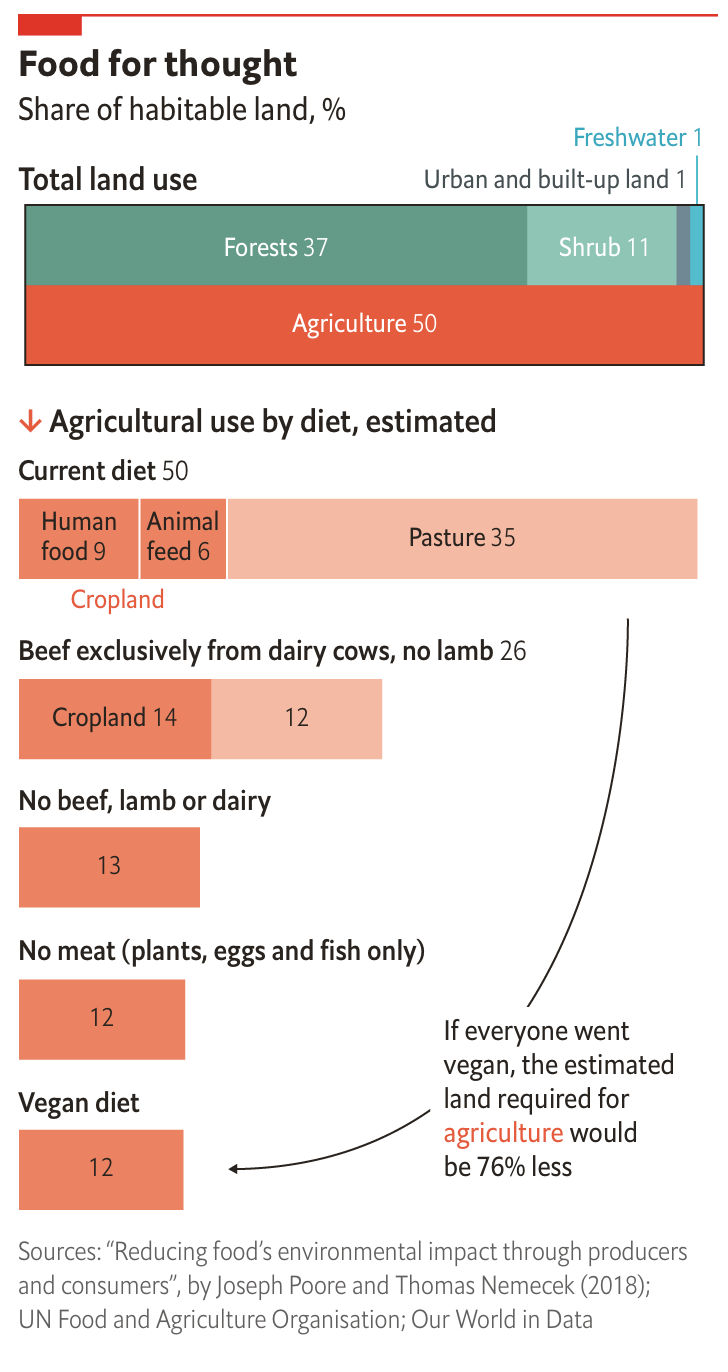
Once in a while, I’ll read an article that makes me take stock (again) and realise how absolutely insane our* civilization (species) is. Today, it’s this article from The Economist, If everyone were vegan, only a quarter of current farmland would be needed (paywalled but you can see the chart below, and it’s nothing new data wise). Now, granted, chances are that we’ll never have a 100% vegan global population but it gives a good idea of the scale.

Below I’m not going to expand on all the issues, just a quick list off the top of my head, and a couple of posts I’ve written elsewhere. Imagine you’re coming from another planet, you look at what ‘we’re’ doing, compare that to what this planet can sustain, and tell me we don’t look completely barking mad.

  • We’re still divided in hundreds of countries with immensely unequal living conditions and access to food, shelter, etc. Even within countries, huge inequalities remain between people, often along gender and racial lines.
  • Our cities are built around cars that spew out a gas causing health problems and causing the planet to warm beyond the best (only) living conditions the species has ever thrived under.
  • The vast majority of the materials we use to build roads and shelters also produce the same gas, pollute in myriad other ways, and we’ve created so much that it has now exceeded the weight of all global living biomass.
  • Plastic is produced, and disposed off, at a rate choking our rivers and oceans. Micro-plastics are now in our bodies from birth, because they are so prevalent around everything we accumulate around us.
  • As mentioned at the start, three quarters of the land we use for agriculture is spent on raising animals in factories and kill to eat (minus the part we torture for the mothers’ milk). In the process we decimate ecosystems, pollute rivers, and destroy arable land.
  • Not only that, but we then go on and waste a full third of the food we produce (40% in the US).
  • Most societies on the planet are addicted to consumerism, buying and replacing ‘stuff’ at historically unprecedented rates, destroying and polluting evermore ecosystems.
  • Planet-wide, we have been struggling with a virus that we might be able to stop but some individuals keep thinking only of themselves and, more importantly, we are letting companies make billions of dollars in profit instead of spreading the vaccines far and wide around the globe.
  • ‘We’ are addicted to ‘productivity,’ convenience, too often blind to what’s going on, barely lifting a finger, by and large making little effort to change things. Those who have the privilege of voting often don’t, too many of those who do choose a short-term feeling of security over long-term viability and equality.

The list could go on, and yes, I could also come up with a list of positives, Future Crunch share a lot of good news, it’s there. But that doesn’t make any of the above less true. We might get out of the current predicament, we can do better, we are doing better in some cases and places, but really, can you honestly tell me that looking at us right now as a species, we don’t look absolutely insane?

* Obviously, ‘our’ and ‘we’ are not great here, considering inequalities at various levels, but let’s use them to mean the human race, in general.

Ceci n'est pas une weeknote

Ceci n'est pas une weeknote

After a very quiet summer, suddenly a few excellent meetings / opportunities this week, and a couple of fun calls. It’s not often that that happens or that I spend so much time productively on Zoom, so a very irregular (as in, almost never) weeknote to keep a small trace of the moment(s).

  • Excellent meeting related to curation.
  • Very fun General Seminar on AR but more importantly a two hour conversation with smart people.
  • Excellent first meeting for project BROWN.
  • Another fun conversation, this time with Jorge for his podcast. (The man seems to be very well organized, because he’s got a bunch of other interviews in the can, I’ll only be up in a couple of months.)
  • In person coffee (!!) for a specific topic that I’ll keep to myself, but that might end up with echos of the Research Studio.

Depending on what pans out for the work related ones, I could be in a pretty different work “geometry” before the end of the year. Exciting!

(In the mean time though, keep the inquiries and meetings coming, I still have 2-3 days availability for work starting… now basically.)

Twenty-twenty

Yesterday a friend mentioned he was kind of disappointed at the level of “pandemic anniversary” articles he was seeing and asked what we take away from that year. I’m not sure my reckon written as a stream of consciousness will be any more useful, but here goes.

TL;DR: I think the year, and here I include the pandemic, Black Lives Matter and ever-clearer signs of the climate crisis, amplified fractures and made them more visible. Some people will have noticed actively, some will have perceived them without specifically understanding, and it’s too early to tell if that changes anything.

First, fractures of inequality in all its forms. Racism, sexism, money, hemispheres, generations, species. All of these were, in one way or another, made more evident during 2020. A lot more people finally realized the extent of the systemic disadvantages of BIPOC people; women took and were given overwhelmingly more pressure than men; essential workers became known as such but not valued accordingly on their pay checks and resources; the one percent were seen as inessential but got trillions of bailouts; the north kept at its insufficient promises while the south kept feeling the brunt of the climate crisis; the living adults kept extracting from their children and unborn generations; humanity kept destroying other species.

Nothing new in any of this but all of them more visible. Some of those sensible to each divide might be stronger in their will, but has the majority opinion changed? To be continued, as they say.

Another divide is the individualistic one. By which people often mean that for many it’s “me, myself, and I.” For my part, and I think for many more after 2020, it’s now understood as something deeper. The focus on the individual participates in our forgetting how important and collectively-built our social and material infrastructures are, which we see in the under-financing and lack of trust in our institutions (plus, you know, neoliberalism policies, and endless influence and lobbying by the rich). It also means people focus on liberties for themselves but rarely on responsibility towards others. And finally it means that even those who, initially, agree with collective policies like restrictions and masks, will easily ignore them when they think they know better, or deserve a break. It means “well yes, but I” quickly takes precedence on “yes, that rule makes sense.”

Another understanding that has shifted in the past year is in what’s possible. Through the discourse of our political “leaders,” many economists, and well, most people, thought that the economy can’t be stopped, that all of this activity and consumption is a great unstoppable mass, that any policy needs to be slow and incremental for anything to change. And then, bam!, we realize that there are breaks that can be used to stop things quickly when there is the will to do so. We can close things, stop planes, find money, set things up relatively quickly. Yes, there are missing gaps, yes some things still take too long, yes stress fractures appear in some places, but it can stop. Massive change can happen quickly.

All of these things flow into a loose interpretation of the Overton window. “The range of policies politically acceptable to the mainstream population at a given time.” Many, many, many more people now better understand the inequalities of their society, see more clearly some of the fictive constructs of the economy, see their neighbours / countrymen and women / humans on this planet differently (for better or worse).

I’d like to think this new understanding will shift towards more mutualism, towards being better neighbours, and better ancestors. But we don’t know yet. I see the problems with enacting, executing, and accepting pandemic measures and think we must do better, but will more people realize we are “all in this together” or will those bucking the restrictions sway further towards their “liberties”? We’ve got elections coming within a year in Montréal, then Canada, and then in Québec later on. Will votes and dreams sway towards the collective solutions we need to face these challenges and reinforce our society? Or towards anger and more a brittle society where each can (wrongly) feel they must concentrate on living and protecting their own lives, and everyone else be damned?

In the end that’s my takeaway from 2020; more clarity on the fractures in society and problems in our infrastructures. In Québec that’s seeing the brittleness of our health system, elsewhere it might be something else. Will this clarity sway public opinion one way or the other? Will it reinforce beliefs, and things don’t move? Depends if I wake up realist-pessimist or in an hopeful mindset.

Adding something of value and longevity to ‘culture’

Nice way of framing what many indie publishers feel but don’t necessarily put into words.

The print world serves as a kind of refuge from that feeding frenzy. In a field where success usually means ‘breaking even’, I think what motivates print publishers most is the belief that they have something meaningful to contribute to their chosen niche. It sounds corny, but adding something of value and longevity to this thing we call ‘culture’ is a major driving force behind so many indie books and magazines you see in your local bookstore. The friction inherent in creating physical goods and – for better or worse – the low expectation of financial reward breed a certain conviction to the cause that feels refreshingly genuine.

Source: Dense Discovery – Archive